Monday, 18 June 2012

Delta Blues: A Day at Pi-Ramesses and Tanis


First published in Al-Rawi: Egypt's Heritage Review, Issue 2 (2010) - http://www.rawi-magazine.com/   and http://www.facebook.com/pages/Al-RAWI-Egypts-Heritage-Review/130048000384044

I inspect Ramesses’ giant feet; they are cracked and worn, and his toenails are as big as my head. It’s a little against decorum for a commoner like myself to get so close to the Good God’s toes, but I suspect he won’t mind, he has bigger things to worry about after all, including the loss of his entire body above the ankles. That, and he’s stuck in a field, surrounded by crops, farmers and an inquisitive gamoosa.  “What happened to my fabulous city?” he might say, if he had a mouth.
Ramesses’ colossal feet are the only significant visible remains of the ancient city of Pi-Ramesses, one of the most important royal cities of New Kingdom Egypt. It was founded by Seti I of the Nineteenth Dynasty on the site of his family’s hometown in the northeast Delta, but was expanded significantly by his son Ramesses II into a massive cosmopolitan centre, with monumental temples, luxurious palaces, homes for visiting foreign dignitaries, administrative buildings, and workshops for all types of craft.  

I look up from the stone feet, and spin around. There are leafy green crops for as far as I can see, cut through with deeply churned tracks. A modern mosque, painted yellow, squats in the distance, surrounded by trees, its single minaret piercing the blue sky above. I pick my way across the clumpy black earth back to a narrow tarmac road, plied with aging taxis and tuc-tucs, propelled chiefly by the bass beats banging from their oversized speakers. Across from me, and over a dirty canal, is the village of Qantir, Pi-Ramesses’ modern successor. It is a place of dusty streets, lined with low red-brick and concrete houses, where loud children ride donkeys past tiny stores selling chocolates, crisps, soft-drinks, and even mobile phone accessories. An old lady in black squats by the side of the road selling tomatoes, courgettes, carrots and peppers, an antique set of scales to her side. Clothes, hung out to dry, billow in the light breeze on balconies above. Nothing betrays the city’s illustrious past; this could be any small village in Egypt.

Lost Cities
The most striking thing about Pi-Ramesses today is its complete disappearance. There is something peculiar about standing on the spot where a vibrant and influential city once met visitors from across the ancient world, and seeing no sign of its existence. But Pi-Ramesses has shared its fate with much of the Delta’s archaeology. Unlike in Upper Egypt, where the dry desert and abundant natural rock led to the survival of many ancient sites, in the Delta any mud-brick remains have long since been ploughed away into the fields; people have cut up the ancient stone temples, reusing them as doorsteps or handy building materials; and the high water table has decayed many of the perishable artefacts that might once have provided a window into a vanished world.

The ancient Egyptians themselves also deserve their own fair share of the blame for endangering Delta sites. Once Pi-Ramesses’ nearby canal – the city’s main raison d’etre – dried up at the end of the New Kingdom and the city declined, much of its stonework was dragged over to the new royal city of Tanis, about thirty kilometres to the north (the workers must really have enjoyed that job). Back in the modern day, finding little left at Pi-Ramesses, and having been underwhelmed by Ramesses the Great’s great toes, I decided to follow the stones, to see what remained of this other great Delta city.

Next Stop Tanis
I drive along the canal road heading north from Qantir towards San el-Hagar, the modern village beside the great archaeological mounds of Tanis.  Along the way I pass a large sign, which reads “Bien,vinu a’Tanis,” as if I’m arriving at some quaint medieval town in southern France. Soon after, I come to a halt at the bottom of a great earth hill, its hues holding a monopoly on every shade of brown imaginable. This is the accumulated soil and dirt of thousands of years, worn by the city’s remains like a grave wears a cairn. It’s all rather desolate, and I get the feeling no one is going to offer me fine wine or cheese. I cross the dusty car park, take a couple of snaps of two scrawny feral dogs, who run up to meet me with wagging tails, and buy a ticket from a guard, who seems just as pleased (and surprised) to see me. I get the feeling Tanis is seldom visited. I climb the mound, passing the excavation team’s dig house and other small buildings along the way, to survey the surrounding area. The undulating mound stretches off in all directions, dotted with an orderly queue of electricity poles, bringing power from distant apartment buildings and mosques to the isolated guard’s huts and the dig house. The modern urban sprawl surrounds the site, constantly threatening to invade it, and is only held off, like the Mongol hordes from China, by a single great wall.

At the end of the New Kingdom, Tanis was only a small port, merely a blip on the political radar, but it quickly developed into a major royal city under the kings of the Third Intermediate Period – a time of political instability, beginning with the Twenty First Dynasty – because of its excellent location as a trading hub, and because the dynasty’s founder, Smendes, called it home. These kings ruled from the city, leaving the pompous priests of Amun to do as they wished at Thebes in the south. The god Amun now ruled there, his wishes interpreted by the high priests who had effectively wrested power from the pharaohs at the end of the New Kingdom. Having lost control of Egypt’s most important temple, these wily northern kings devised a cunning plan, “if we can’t control the temple anymore,” they said, “let’s just build a new one.” And so they did, building a replica of the Temple of Amun from the remains of Pi-Ramesses, like children unleashed in a box of spare Lego bricks, along with a Temple for Amun’s wife Mut and their son Khonsu for good measure.

On the way to the temple precinct I pass half-preserved statues and shabby decorative blocks, lining either side of a dirt path. To my left, the upper half of a statue of Ramesses II stands smiling inanely into the distance, as if lobotomised; further along is a roughly formed White Crown, missing a head to hold it aloft; then a pair of legs to my right, lacking a body; and a single stone head, its eyes bulging manically near the centre of its round bulbous face. Standing decrepit, watching me walk between them like spectators to their own funeral procession, the statues are a grim reminder that
nothing lasts forever, not even the whims of kings.

Then, passing through a gateway, nothing more than a rough collection of blocks really, I enter the scattered remnants of the Precinct of Amun. As if picked straight out of Percy Shelly’s brain, the temple’s remains are the very definition of a romantic ruin; the Victorians could have picnicked and sipped tea among them for days, while prattling on about Ms. Barnaby’s marriage prospects and the scandalous affairs of the Duke of Essex. A broken obelisk, a colossus lying on its back, a block bearing scenes of smiting pharaohs, a pair of feet. They are all just there, defeated and sad, as if time itself had come along and kicked them all over, saying, “that’s what you get for thinking you can beat me.” Unlike the earlier grim procession, with its forced order, it is the sheer spread-out, random higgledy-piggledy nature of these ruins that give them their beauty, and appeal to that moustachioed inner adventurer who always wanted to happen across a long lost city in the desert. 

Royal Tombs and Treasure
The Tanite pharaohs were so proud of their 1:1 scale replica of Karnak’s Amun Temple that they decided to be buried there, only to be unearthed again by Pierre Montet in 1939. A great departure from the better-known royal burials in the Valley of the Kings or the pyramids, these tombs are almost humble in appearance. If I hadn’t known where to find them, I would’ve thought they were just simple stone-lined rooms, sunk into the ground beside the temple’s first court. A set of modern steps take me to the roof of one tomb, from where I peer down into its confined, garage-sized space. Within are two simple stone sarcophagi, and walls inscribed with royal underworld books. The location and simplicity of these tombs betray an increased sense of dependence on the gods, rather than one of opulence and unique position. I get the feeling these kings were thankful simply for being able to exercise their right to rule, and didn’t want to push it all too much by demanding anything too extravagant – at least architecturally. When found, these tombs were stuffed with treasure (they were still kings after all): high quality golden masks, jewellery, and a unique silver hawk-headed coffin that belonged to King Shoshenk II were all among the finds. Despite ruling at a time of economic difficulty, the Tanite kings were not impoverished, and may even have used some of the gold emptied from the Valley of the Kings to forge their own luxurious grave goods. All of these can now be seen in the Tanis Treasure room in the Egyptian Museum, Cairo.

Saving the Delta
Both Pi-Ramesses and Tanis shared a ruinous fate; the former is now almost invisible and the latter is a mound of broken memories. Still, thanks to excavation, recording and conservation, both sites have been saved in their own way. Tanis might have the upper-hand as a tourist destination, thanks to its romantic remains for visitors to get lost among, but thirty years of excavation in the fields of Qantir, as well as geomagnetic survey, have brought that vast city’s layout back to life too (just in a less obvious way).

Many other less fortunate cult centres and cities remain to be unearthed from beneath the Delta’s fertile soil, some disappearing as you read. Despite archaeologists being aware of their existence, they still await excavation and, although – as all first year archaeology students across the world learn on day one – excavation is destruction, in the case of the Delta it is rescue. Each day, another foundation wall becomes unrecognisable, another valuable piece of everyday life becomes that bit more decayed, another piece of history vanishes. Still, it’s not all bleak, in recent years much has been done to try and rectify this problem. Projects at sites such as Mendes, Kom Firin, and Sais have revealed much about the later stages of Egyptian history, while the Supreme Council of Antiquities (SCA), in addition to conducting its own work in the Delta, has restricted new foreign missions from excavating south of Cairo, effectively forcing them to take their trowels northward. At the same time, some Delta sites are receiving a facelift, such as Bubastis in Zagazig, which recently received a new visitor’s centre and an open air museum.

As the average tourist sees only an empty green void between Giza and Alexandria, these developments can only be a good thing; it’s taken a long time, but the spotlight is now firmly shining on Egypt’s northern archaeology, redressing the imbalance in our knowledge. Remember, wherever you go in the Delta – and please tell Ramesses this if he asks you where his fabulous city has gotten to – there are wonderful things waiting to be discovered, right beneath your feet.

Akhenaten's Akhetaten: A Day at Tell el-Amarna

First published in Al-Rawi, Egypt's Heritage Review Issue 1 (2010) - http://www.rawi-magazine.com/ and http://www.facebook.com/pages/Al-RAWI-Egypts-Heritage-Review/130048000384044

The Aten
“Why are my messengers kept standing in the open sun?....They will be killed in the open sun,” wrote the Assyrian king Ashuruballit I to King Akhenaten, following the return of his sunburnt and weary envoys from the newly founded Egyptian city of Akhetaten, ‘the Horizon of the Sun Disc – better known today as Tell el-Amarna.[1]

The main problem, it seems, was the new religion, instigated by the pharaoh himself - King Akhenaten. Thanks to Akhenaten’s particular beliefs, gone were the multitude of interestingly-headed gods, unusual netherworld beliefs, and dark secluded sanctuaries in which Egypt’s deities would be served by submissive priests during arcane ceremonies. Instead everyone had to worship the sun disc, known as the Aten, through the king himself as intermediary. Indeed, Akhenaten loved the Aten so much that he had earlier changed his name from Amenhotep IV to honour the new state god. For visiting foreign envoys, such internal religious matters might not normally have played heavily on their minds; however, since the new pharaoh’s sun worship meant doing business standing out in the midday sun, in open courts, without any shade, for extended periods of time, things had become rather unbearable. Sweating whilst watching the young king perform his daily rituals, any visiting envoy would find it easy to pine for the good old days of the god Amun – the Hidden One, cool and fresh within his dark sanctuary – and wonder what in Aten’s name was going on.

Visiting Tell el-Amarna
Just as many ancient foreign envoys might have wanted to avoid visiting Tell el-Amarna, most modern tourists also skip seeing the site, despite its rich archaeological and historical significance. So, in order to highlight this touristic travesty, I decided to venture there myself. I stayed in Minya, a beautiful, clean city, about four hours from Cairo by train, bizarrely equipped with its own Hollywoodesque “El Minya” sign up in the surrounding hills; from here it’s an easy taxi ride to the ancient site. Well, except for the river getting in the way.

My taxi ground to a halt alongside the riverbank, becoming one of many vehicles anxiously waiting for the ancient green ferry to putter its way across the Nile, pick us up, and deliver us to the village of El-Till on the other side. From a distance the ferry looked like a home-made aircraft carrier, adapted to house an excessively large floating community of cars, trucks and about forty people. From my distant vantage point I could see five life-rings hanging from a wall, while a little further down the river a similar ferry looked to be slowly sinking; all in all not good signs.

Still, all along the riverbank the local villagers were washing their clothes, while children played beside them in the shade of tall palm trees. Just another day in the village, I thought to myself, this boat’s been doing this journey for at least five hundred years; it would be unbelievable bad luck for it to sink today. Twenty minutes later, and onboard, I decided to calm my fears further by making small talk with the captain, only to find that he immediately and quite happily passed over control of the boat to me. Bolstered by my sudden promotion, my fear of sinking was left behind and I steered us on a good course to the east bank of the river. I was going to enter Amarna in style – the captain of my own boat. The real captain had a cigarette break.

The City of Akhenaten
Visiting Amarna today, it is difficult to envision what sight greeted any diplomatic envoy who begrudgingly went there three thousand years ago – during the period of Egypt’s 18th Dynasty. The city today is a moonscape, with virtually nothing evident on the surface. However, from archaeological excavations we know that it was planned from the outset as three major sections, today labelled the north suburb, the central quarter and the south suburb. These were connected by three roads, heading north-south. Altogether, it is thought that about thirty thousand people lived within this space, many probably wondering what they were doing there.

The Northern and Southern Tombs
The first major attraction at Amarna is the private tombs. The nobles and officials, who were presumably forced to move to Akhetaten in order to continue their careers, were also to be buried there; apparently it wasn’t enough to abandon your traditional beliefs for the sake of your career, you had to abandon them for eternity too. Obviously Akhenaten couldn’t create an entire new capital city without the help of the government and military, and so it puts a nice spin on the common perception that the Egyptians were obsessed with religion, tradition and order, knowing that these ancient politicians (just like modern politicians) did whatever was best to further their careers. “You want to keep your jobs,” Akhenaten probably complained, “you’re moving to my boiling new city in the middle of nowhere and worshipping who I tell you! And bring the wife and kids.” It must have been a bit like being forced to join one of those wacky cults that occasionally spring up in remote parts of the USA, except without the alien obsession and FBI surveillance and a lot more standing around in the sun. 

The tombs are split into two groups, today known as the northern and southern tombs, cut into the cliffs to the east of the city. My first stop was the Northern Tombs, which lie up a steep, long slope. Panting and out of breath as I followed the rock-lined path to the top of the cliff, I then followed the tomb guardian along the ridge as he slowly opened the tombs one by one. While waiting for the tombs to be unlocked, and their heavy metal gates to be swung open, I walked to the edge of the escarpment and looked out over the desolate archaeological site. In the far distance was the cultivation, followed by the river; the yellow sand, green fields and blue water starkly contrasting with one another as they disappeared towards the horizon.  

I entered six of the rock cut tombs: one being the tomb of Huya, who was Overseer of the Royal Harim and Steward of the Great Royal Wife, Tiye – the mother of Akhenaten – who apparently came to visit the new city in her old age. Other tombs belong to Akhenaten’s priestly staff: the High Priest of the Aten, and two Chief Servitors of the Aten. One of these tombs, that of Panehesy, had been adapted into a Coptic church in antiquity.

The southern cluster of tombs is not as impressive as the northern group, and many were left unfinished when the city was abandoned. Still, of those that can be seen, one belonged to the God’s Father Aye, a man who would later become king after Tutankhamun’s premature death, while another was for the Chief of Police. Another tomb belonged to an Overseer of all the Works of the King, whose name has been erased throughout his tomb showing that he had fallen from favour. Throughout each tomb images of the king’s life and family dominate the walls – the king’s journey from his palace to the temple; the king’s bestowal of office or reward, the royal family together - all executed in the unique exaggerated style of the period.

The Royal Tomb
After visiting the rock cut tombs of the nobles, I visited the tomb of the heretic king himself. Akhenaten’s tomb lies down an atmospheric wadi; empty and quiet except for the wind that occasionally rumbles past your ears as you stand in the shade of the surrounding cliffs. Although open for some time, lighting and walkways have recently been introduced into the tomb, making access much easier than before. As I descended into the dim neon glow, and walked down the long straight axis of the tomb, it quickly became obvious that the decoration had everywhere been attacked by those wishing to extinguish Akhenaten from history, leaving only fragmentary remains behind. It’s hard not to feel sorry for the poor king when his tomb has been so completely decimated. To be honest though, most of the destruction in the tomb was probably done by those that had willingly followed him out there to Amarna; “I had to sell all my cows and my nice house in Thebes to move out here,” you can almost hear one of them yelling, “and then everything you said turned out to be garbage,” before taking another whack at a carving of Akhenaten’s flabby elongated face with his chisel.

Two separate suites of rooms branch off from the main tomb axis. The first, closest to the entrance, may have been for Queen Nefertiti, while the second was perhaps for Meketaten, one of Akhenaten’s daughters. Scenes in the three rooms here show the death of the princess, with Akhenaten and Nefertiti standing over the body of their daughter. Nearby a new born baby is shown, which some scholars have taken as evidence of the young princess dying during childbirth.

The Small Temple to the Aten
Leaving the tombs behind, I ended my tour by visiting The Small Temple to the Aten, where the king would go to make offerings to the sun disc. The road that leads to the temple actually follows the original ‘royal road’ of Amarna, down which the king and his family would ride their chariots under heavy escort to the central quarter of the city. Knowing this, I felt rather regal as I, like Akhenaten three thousand years earlier, stepped down from my vehicle and entered the temple. It was probably a lot more impressive three thousand years ago, however, when there wasn’t a long row of electricity pylons and a flimsy barb-wire fence next to it.

Unlike many of the famous temples of Upper Egypt, little is preserved of the small temple; only its foundations and the modern reconstruction work betray its original size and layout. It no doubt looked a lot more impressive in Akhenaten’s day. I passed through the pylon gateway, and found a large reconstructed altar, originally reached by a few steps, upon which Akhenaten would offer food to the Aten. Then, as I continued along the central axis of the temple, the remains of many columns came into sight; these once stood at the rear of the temple in the sanctuary area. Today, however, only one modern column still stands, sadly and solitarily poking its head in the direction of its long-ignored solar deity.

Looking closely at the area around the temple, I could see mud-brick walls peeking out of the sand in all directions; some stood to a reasonable height, while others could barely be seen above the sand. These were once the great buildings of the central quarter, the pulsing heartbeat of Akhetaten, the storerooms and administrative buildings, all now reclaimed by the environment and slowly baked by the sun.

The End of the Line
After seventeen years of rule, Akhenaten died and his new regime quickly fell apart. The old traditions were resumed and every occurrence of Akhenaten’s name and image were attacked. From that moment on he would be known as the “enemy of Akhetaten.” His city was dismantled, piece by piece, leaving only its bare foundations, and his tomb was ransacked. Even Akhenaten’s sarcophagus was hacked to pieces and left scattered in his burial chamber. It was subsequently reconstructed, however, and can now be found around the west side of the Egyptian Museum, Cairo. Despite the good intentions of the conservators, it is completely unmarked and ignored by the thousands of tourists that go to the museum each day. It is ironic though that despite the destructive efforts of the ancient Egyptians, Akhenaten is today one of Egypt’s most famous kings.

In the end then, despite complaining to their king, I hope that the ancient foreign envoys, who once stood so long in the sun in this tragic experiment of a city, left Amarna with the same feeling that I did as I was driving away in my taxi, back toward the aging ferry – they may have been hot and tired, and slightly concerned about the eccentric pharaoh’s mental health, but I’m sure that they were happy they went, because Tell el-Amarna, the period that it embodies, and the snapshot of history it represents is unique; being there to witness the physical result of Akhenaten’s great upheaval provides a glimpse into something special. For this reason alone Akhenaten deserves his place in history, saved, like his city, from the annihilation of time.


[1] Translation after D. Redford, Akhenaten the Heretic King, AUC Press, p. 235.

Thursday, 14 June 2012

The Poetical Stele of Tuthmosis III

First published in the Egyptian Museum Newsletter, Issue 7 (Jan-April 2010) - http://www.egyptologyforum.org/EMC/EMC_Newsletter_7_Jan-April_2010_English.pdf

The Egyptian Museum contains many wonders, so many in fact that most are passed un-noticed by the thousands of visitors that enter each day; some of the most important objects in the museum are unobtrusive, silently waiting to be rediscovered.

Take for example the Poetical Stele of Tuthmosis III – originally from the Temple of Amun at Karnak and now in Room 12 of the museum’s ground floor among other objects from the 18th Dynasty. It was found broken into two large pieces of granite (CG 34010 and JE 3425), and originally stood 1.70m tall. Although not as immediately impressive as the nearby statues of Tuthmosis III, Amenhotep II, and Senenmut, it displays an inscription that highlights the close personal relationship between king and god. The scene at the top of the stele, in the lunette, emphasises this message for those unable to read the content – below the winged sun-disc can be seen a dual image of the king accompanied by a goddess, both offering to the god Amun.

The inscription below is presented as a speech of Amun, who welcomes the king into his sanctuary at Karnak, calling Tuthmosis ‘his son, his avenger,’ and embracing him. Amun states that he will give Tuthmosis victory over all lands, and, in fact, has already made his previous victories possible. He tied up the Nubians and northerners for the king to defeat, and caused them to fall beneath his feet to be trampled. Due to his divine action, Amun continues, all foreigners will come to the king bringing tribute on their backs.

Amun then relates his happiness at Tuthmosis’ military victories, before making a series of poetical statements, each following the same general structure. With each line Amun gives Tuthmosis dominance over a different part of the world, and causes the people of each area to witness him as a particular phenomenon or creature, each vividly described. Thus, the people of Djahy (in modern Lebanon) see the king as radiant light shining down upon them as the sun’s rays; while those in the Eastern Land and in God’s Land see the king as a shooting star that scatters its flame as fire. Those at the limits of the north were to see the king as falcon-winged, as one who could seize what he sees as he desires, while those who lived in the borderlands and the Bedouin would see the king as an Upper Egyptian jackal - a possessor of speed.

Amun performs these wonders  for Tuthmosis because he, in return, does all that the god desires – the text relates how Tuthmosis had performed work within the temple at Karnak, including building large new doorways, in honour of his god. It thus highlights the nature of the king’s relationship to Amun in the New Kingdom: it is reciprocal. Both act for one another for the greater glory and benefit of Egypt. This stele is a powerful and poetic insight into the nature of New Kingdom thought, and illustrates a very personal moment between the king and his god.

Medieval Fustat: Solitude in the City

First published by Heritage Key: http://heritage-key.com/blogs/garry-shaw/medieval-fustat-solitude-city

A cat wanders by, leading to myself, the guard, my two friends, and the cat being the only occupants of the ruined city of Fustat on this particular day; it was originally home to roughly 200,000 people. This is an unexpected experience for Cairo – solitude in the city.

The Mediaeval Capital
Fustat, the mediaeval capital of Egypt founded in 642 AD by General Amr Ibn el-As, was burnt to the ground (according to Arab tradition) roughly five hundred years later by order of the Vizier Shawar. Frankish crusaders were on their way, and he decided that it was better to have a razed city with a displaced population than a city under occupation. This must rank as one of the most unusual reactions to impending invasion ever concocted (but one that was also used by the Russians during the Napoleonic wars); I can imagine the messages passed down to the general population, “We are facing the prospect of invasion and pillaging by the crusaders –  our defiant response is to burn our city to the ground and run; that’ll show’em. Everybody out by Monday. Yours Sincerely, the Authorities.”

This might be a little unfair on Shawar; the Frankish crusader army, under Amalric I of Jerusalem, had already taken Bilbays, north of Cairo, on 5th November 1168 and horrifically massacred the population. After the massacre, Almaric taunted Shawar by stating that Bilbays was his cheese and Cairo his butter. Thus, Shawar, rightly fearing the assault of a dairy obsessed madman and not wanting a cheese-related metaphor from being applied to himself or Fustat for posterity, abandoned the city in order to save the population and stop it from being used as a base to attack Cairo. Given what happened at Bilbays there isn’t any reason to suspect that the local people opposed his plan.

Tradition and Reality
The story of the absolute destruction of Fustat is, however, only a tradition; in reality the fire was likely limited in scope, restricted to churches attacked during anti-Christian riots, and so not directly connected to Amalric’s invasion. There is little archaeological evidence that large scale burning occurred, and the city continued to exist after 1168, with rebuilding work recorded as carried out after the fire. The area was even included within the protection of Saladin’s city wall. Still though, over time, Cairo (founded in 969 AD) slowly overtook and eventually swallowed Fustat, leaving the earlier capital as a source of building material and fertiliser, before it finally became Cairo’s main rubbish dump – the city’s remains gradually becoming lost under centuries of garbage.

Fustat Today
In recent years the surrounding area has seen some development, thanks to the draw of the monuments of nearby Coptic Cairo, which is visited by large numbers of tourists each day. The remains of Fustat, however, lie forgotten in plain sight. The main problem is a lack of promotion; I stumbled across the massive archaeological site by accident when visiting the Islamic Pottery Centre at the end of it entrance road. Knowing that ancient Fustat had been in this area, and seeing the large archaeological site in the distance, I came closer, but expected to be hurried away by over protective guards (or asked for baksheesh-tips in order to enter). Instead I was welcomed in and asked to buy an entrance ticket (10 LE).

The Archaeological Remains
At first glance the remains of Fustat are more like an abandoned opencast mine than a mediaeval capital city – an impression created at its edges where the grey sloping ground enters the great depression of the excavated area. Palm trees, weeds, cacti, and tall grass are evenly dispersed across the site, and the remains of small fired clay and mud-brick buildings are scattered around. The bricks are held together with thick mortar made from recycled limestone – probably re-used from ancient pharaonic buildings. One house still has its window - three thick slats sitting on top of its mud-brick wall. Columns, lying toppled on their sides, speak of better times; some are made from Aswan red granite, and probably started their lives as elements of pharaonic period temples from the Memphite area, before being adapted for Roman temples and then Christian churches until finally being reworked in mediaeval times. Intricate columns capitals also lie about on the surface.

A large amount of pottery is scattered across the site, as well as being piled high close to the guard’s house. Some are decorated with images of birds, while green glazed pieces can also be seen. There are even clay pipes among the ruins. The next most striking feature at Fustat – and probably the most dangerous if you aren’t watching where you’re going – is the sheer number of wells dotted around the site (almost all without any indication to their presence until you’re standing above the hole). Apparently, nearly every house in the city had a well or cistern system, and the houses themselves are described as being multiple stories high, like a mediaeval New York city.

This is difficult to envision today when faced with the ruinous moonscape before you. There are no information signs (there’s no one to read them anyway), which, despite leaving you a little confused, does lead to a sense of discovery whenever you come across something different. In one part of the site, after having become accustomed to fallen columns and mud-bricks, I came across a series of red granite mill-stones, all left together, and later an oil-press.

Solitude in the City
Cairo is not a quiet city. Even in my apartment I can still hear the incessant honking of the cars below. It’s not a place your Aunt Margaret and Uncle Steve would go for a quiet weekend break to sit by the river and watch the boats go by; not unless they normally have voices in their heads incessantly screaming ‘TAXI,’ ‘FELUCCA (boat rides),’ or ‘Welcome in Egypt,’ and enjoy hordes of people knocking them about on an uneven sidewalk. No. Cairo is famous for being a city with a pulse, where ancient meets modern, and everything is chaotic. This is its charm. It’s hard to believe that Fustat was once the same – a mediaeval metropolis of bustling streets, screaming vendors, rich and poor all living in close quarters. Today this space is an escape from all of that, a quiet bubble where it is possible to reflect on how the world has changed, and how it has stayed the same. Still, at the very limits of the site new apartments buildings rise up, a constant reminder that the modern world, with all its noise, isn’t far away. 

The King and I(deology)

First published by Heritage Key: http://heritage-key.com/blogs/garry-shaw/king-and-ideology

Although there is copious evidence for the Egyptian kings – statues, huge depictions on temple walls, stelae – the actual reality of the day-to-day work and personal authority of these individuals is often ignored in favour of discussions of divinity, art and ideology. There is good reason for this. Despite the extensive amount of evidence available to scholars, everything is shrouded in a thick layer of ideological presentation that masks the reality of the situation. This makes it difficult to separate fact from fiction: what are we to envision the king did every day? Initially, just for fun, it is interesting to see what image is conjured up in your mind when you think of the word ‘Pharaoh.’ What do you see? Is it a stern-faced man sitting in an alarmingly short kilt with an elaborate crown, being adored and bowed to by subservient followers? Or a warrior king riding on his chariot at the enemy line, firing arrows while steering with the reigns tied around his waist; the army trying to follow behind, but simply unable to keep up? Don’t worry if these are your initial thoughts, they are images that have been fostered over a long period of time – the image that the Egyptians themselves wanted to present – and television has played a big part in recent years to reinforce the ancient propaganda.

Approaching the ancient evidence requires a large degree of scepticism and the need to push aside any preconceived notions regarding who the pharaohs were. We are, after all, delving into an alien world – familiar yet not. Our only window into this world is the evidence that lies before us, which presents a certain foggy picture rife with distortion. Distortion occurs in many forms: first there is the simple human need to simplify – it is impossible to describe all aspects of everything that ever happens, and so from the beginning the Egyptians are only leaving us a certain fraction of their experience. Next there is conscious distortion, the product of ideological manipulation. The vast majority of textual sources available to us are subject to decorum – the rules that regulate how an image could be presented and what a text could say in any particular context. Evidence relating to the king, unsurprisingly, is the most affected by this.

As defender of maat – the Egyptian sense of order – the king must be presented performing any action that continues this stability: he offers to the gods, he kills all enemies, he leads the army, he widens the borders of Egypt. He does this personally. Things must continue as they always have. This is quite clear in art, and it is the same in texts. In order to strip away these layers of ideology we must approach the texts with issues of genre, theme and context in mind. Context because the location of a text will give away why the information was recorded in the first place, and genre and theme in order to understand what information is being manipulated.

Egyptologists have identified many of the key themes that emerge in textual sources, and it is also possible to see switches in genre within individual texts. The scribes who composed these texts did have accurate records available – these are known as daybooks, and record the date, name of the king, and important details required by the administration in a plain straightforward manner. If it was the daybook of the royal palace, it would also record the location of the king, his movements and activities. Such daybooks formed the core of many royal inscriptions, which could be stored in the palace archive, and their original content can often be deduced from the official ‘publications.’ Sometimes the same basic administrative record could be used by different scribes to produce different recreations of events. Amenhotep II of the 18th Dynasty commissioned two stelae to record the events of his military campaigns into the Levant – one would be placed at Karnak Temple in the south, and the other probably in a Temple at Memphis in the north (this stele was found re-used in a later tomb in the region). Both were thus religiously motivated. Seemingly the same daybook information was sent to the scribes in the north and south, but they did not work together on their compositions. Both stelae relate the same basic events, except in cases of royal valour when the scribes followed set themes to portray the king in the best possible light (normally at the expense of the army). Whilst crossing the Orontes river, the Memphis stele describes how the king saved his army by chasing down the enemy and killing them all with his arrows; the Karnak edition, however, simply records that he chased down the attackers and killed the enemy commander with his battle-axe, while the rest of the troops fled. Such descriptions follow exactly the depictions of the king in battle. The narrative switch from plain record of events to ideologically motivated fiction – the raging king, majestically attacking the enemy alone - is motivated by the need to show the king as defender of maat, controlling the chaos of the battle, while protecting the people of Egypt – here represented by his army.

What then was the king’s true role as warrior on the battlefield? If all evidence relating to the king is inherently biased will he forever remain an ever present yet elusive figure? Regarding military texts, at least, if we strip away the ideological flourishes and simply try to recreate the original daybook entries from which the text was composed we are left with very little information to solve this problem. The evidence becomes neutral as to whether the king personally fought with his troops – it won’t allow us to say whether he did or not. We have to look elsewhere to tip the balance of probability. So, for example, there is only one royal mummy that shows any sign of battlefield injury – and there is always the possibility that he was assassinated in the palace. None of the great warrior pharaohs of the 18th Dynasty, such as Amenhotep II, show any trace of wounds or injury. In fact, the great warrior Ahmose, who is described as liberating Egypt from the Hyksos invaders, is described by one scholar as ‘delicately built,’ and probably unable to be a front-line war leader. There are also references to the king’s bodyguard in some textual sources, and also to his protection when travelling in Egypt. Ignoring the ideological presentation of the king, and viewing this evidence objectively, does this not tip the balance of probability in favour of the kings not personally fighting, but having to be presented so for religious reasons? Firm evidence as to the reality of the situation may forever elude us, but sometimes there are hints at what may lie behind the shroud of ideology.

The Potters of Fustat

First published by Heritage Key: http://heritage-key.com/blogs/garry-shaw/potters-fustat

If you’ve ever wanted to own a perfect hand-crafted piece of traditional Egyptian pottery made by a man with only one thumb and one eye I can tell you exactly where to go. His name is Salah and he lives in Fustat, in the area better known today as Coptic Cairo.  

Getting to Fustat
It’s an easy journey, you can take the metro from downtown Cairo there in no time at all, roughly only fifteen minutes. Then, after arriving, you get to confound the local tourist police by walking away from all the wonderful ancient churches, and straight down the dirty roads that surround the tourist precinct. They’ll tell you that you can’t go down this street or that street, that you’re heading in the wrong direction, but just keep walking; they’re trying to be helpful in their own way, because no one these days goes to visit the potters.

There have been potters living and working in this area since medieval times and, despite being shifted around by the Egyptian government, they can still be found close to the archaeological remains of Fustat – the first capital of mediaeval Egypt - continuing their traditional trade below the imposing city wall of Saladin.

Salah’s Workshop
I passed behind a modern pottery display area, situated on the edge of a busy main road to tempt drivers into making a purchase as they pass by, and entered the first workshop that I could find. It was made of stone and mud-bricks, with a roof half covered by straw and wood, and a dirt floor littered with straw. Within I met Salah, a warm welcoming man, who smiled and laughed, causing his face to crinkle with the type of wrinkles only etched into those that have lived a hard life. He is unshaven, and a cigarette hangs limply from his mouth. He introduces me to his two sons, Amr – who I’m told carries out the fine decorative work – and his younger son Mohammed, who is normally at school.

After the pleasantries Salah springs into action, grabbing a lump of clay with his rough hands from beneath a sheet of plastic, and carrying it over to his roughly constructed table, sunk slightly into the ground and held together by old nails and thin pieces of rope. He throws the clay on to a spinning wheel, cut into the centre of the table. Below, his feet rhythmically control the spinning of the wheel, surrounded by the curling remains of discarded clay that litter the floor. Seconds later a perfect pot sat upon the wheel, formed by the use of a scraper positioned on Salah’s first finger. At this moment I realise that he only has one thumb, and one eye to match, making the quality and speed of his work even more impressive. Give me a lump of clay, a wheel, and a few hours, and I’ll produce for you something resembling the elephant man’s face – Salah made five further pots in less than five minutes.

Making Pottery Fustat Style
Suitably impressed I decided to walk around the small workshop to get an idea of the process involved – I quickly learnt that it is the preparation that takes the time, not the actual shaping of the clay. Outside the workshop was a large trough; this was for levigation – the first part of the process, in which wet clay is left to stand and dry, causing the top layer to become finer, and the coarser particles in the clay to sink. The potters then scoop out the top layer and bring it to another trough within the workshop. Here the clay, which is mixed with higher quality powdered clay from Aswan in the south of Egypt, is brought and mixed with water before being trodden until it becomes more elastic and workable. From here it is piled up beneath a plastic sheet, next to the trough, ensuring that the clay stays evenly wet.

Once made, each pot is left to dry for up to a week before being fired in a large outdoor kiln – any moisture left within the pots could cause cracking during the firing process. The kilns are loaded with burning wood at the bottom, and then the vessels are placed in the middle, above the flames; the roof is pierced with a series of holes to allow the smoke to escape. The doorway of the furnace can be made bigger or smaller, in order to control the amount of oxygen within. The kilns have a limited lifespan; the constant firing eventually causes the bricks and clay to crack and the structure to begin to disintegrate. Salah’s kiln had been dormant recently, and it clearly needed some repair before it could be used again. Others were certainly in use, however, as the entire area smelled of burning.

Walking around outside, you could be forgiven for thinking you were standing on an archaeological site; everywhere broken pottery sherds emerge from the ground, slowly being covered by straw and dust until their existence is completely hidden. The main activity around me was roof tile production; young children carried them around on their backs, transporting them to open flat areas where they could lay them out on the floor so that they could dry for up to a week in the sun; a series of tiles had been unceremoniously stepped on by a dog, leaving full paw prints embedded in the clay. Up to 3000 tiles can fit within a single kiln, and they sell for only 40 piastres (about seven cents) per tile in the display area along the road.

Moving with the Times
Although working mainly in a traditional way, the potters have been forced to move with the times in order to keep business alive, leaving the time-honoured vessel shapes, such as the large zir– water pots or small gulaa, behind. Today, in the display area you’ll mainly find a variety of moulded ornaments, such as large frogs covering their faces, mushrooms, cups emblazoned with large letters, and other such items that would be at home in your local garden centre. They even sell large ceramic fish - cute, but far from traditional - for about 20 LE ($3.50) each. I’m startled by how cheap the items sell for, and also by the honesty of the shopkeepers when telling me the prices; if this were anywhere more touristic the starting price would be five times that, and could only be haggled down to twice the standard price after an hour of talking and thirteen cups of sugary tea. Even then the shopkeeper would still behave as if you’d insulted his mother and kidnapped one of his children.

Even the potters’ overall environment is about to change – the small mud-brick workshops are slowly disappearing, replaced by new, modern buildings behind. This is such a massive cultural shift that anthropologists from the Netherlands have been documenting the lives and practices of these people before it is lost forever. The changing work of the potters is also seen in the broken moulds that litter parts of the floor – standardised shapes, that are quick and easy to produce.

Before leaving I return to Salah’s workshop one last time to find he and his family repairing their kiln with old pottery sherds and clay; things are changing for the potters, but in the meantime life must continue in the way that it always has. It is a hard and dirty life, and soon to vanish forever; whether the traditions will survive modernisation will only become apparent with time. I say my goodbyes and take the road back to the metro station; close to the station, and firmly back in the tourist zone, I pass a rather familiar ceramic fish sitting outside a small shop – ‘only 110 LE,’ the vendor shouts, noticing my attention, ‘good price.’ Things really can change very quickly. 

Egypt's Desert Whales

First published by The Independent (http://www.independent.co.uk/environment/nature/english-voyager-finds-whales-in-egyptian-desert-1833430.html) and Heritage Key (http://heritage-key.com/blogs/garry-shaw/desert-whales-egypt)

Driving through the desert in search of whales sounds counterproductive, but I had been assured that if I hired a jeep and drove seventy kilometres from Egypt’s Faiyum Oasis out into the Sahara this is indeed what I would find.  If this was a ruse it was a clever one, and UNESCO were in on it.

The cream coloured 4x4 arrived at nine AM.  Perfectly on time – a good sign.  The driver, Mohammed, was a youngish man, perhaps in his early thirties, sporting a thick goatee beard and wearing a red and white chequered headscarf.  He smiled and shook my hand.  He had a confident air about him; this was reassuring as effectively, out in the desert, my life would be in his hands.  The vehicle was less reassuring.  Of unknown origin, it looked as if it had been driven from Russia the long way around the planet.  On one side it was painted with the words, ‘Land Croser’, and on the other, ‘Land Roser’; a leaping leopard was emblazoned upon the front doors on both sides, but the image to the right had faded until only the leopard’s spots remained to form its feline shape.  The vehicle was clearly the closest a machine could get to being un-dead, having been resurrected again and again by Egyptian shamans of engineering.  A young boy of thirteen or fourteen sat in the front passenger seat; apparently he was coming along for the ride as Mohammed’s apprentice.  This was again reassuring; it meant that Mohammed had done this sort of thing before, at least enough times to act as a teacher.  The sombre shape of the vehicle was now less threatening and became more a symbol of adventure, something a more perfect machine couldn’t embody. My mind began to draw pictures of the rickety old jeep, driven by Mohammed, valiantly fighting through the desert dunes to the isolated valley where I would find the remains of ancient whales jutting out picturesquely among the rocks.

Despite the reassurances, my initial nervousness of travelling in this part of Egypt was well founded in experience.  The first time I’d visited the Faiyum my trip had been violently brought to an abrupt standstill by an exploding tyre.  I spent the second journey huddled up at the back of my taxi, trying to keep myself warm after the windscreen had been shattered by some unseen high velocity projectile.  In order to keep moving the driver had punched a hole in the shattered glass just big enough to see out.  Naturally, this odd situation received no attention from the police.  I had decided then and there that my travels in the Faiyum were cursed.  Heading out into the middle of the desert in an old soviet ‘Land Croser’ could thus, very reasonably, spell doom.  Just as my mind had drawn romantic visions of desert travel and ancient remains, my mind also drew images of a burnt out soviet wreck far from the road, half buried in a dune, the pathetic charred remains of a leopard barely visible on the blackened, baked side of the vehicle, Mohammed wandering in circles dazed and confused in the darkness, while I stand alone wondering how long it would be polite to wait before I could kill and eat Mohammed and his apprentice, cooked over the burning remains of our 4x4, in a desperate bid for survival.

The contrast seen by the ancient Egyptians between the fertile Black Land of the Nile Valley and the chaotic desolation of the Red Land – the desert – is still very noticeable to anyone travelling from the lush agricultural Eden of the fields into the Western Desert.  Driving through the Faiyum I was met by scenes of leaning palm trees, all bowing in the same direction to some unseen master, donkeys carrying heavy loads twice their size, farmers standing in the fields carefully tending their crops in the sun, and bored looking cows and gamoosa-water buffalo standing and staring contemplatively at passersby.  Behind them all, Lake Qarun was glimmering in the sunlight, while the distant desert hills beyond glowed a yellowish-red, emanating and sweating heat. 
The whales were in Wadi El Hitan, ‘The Valley of the Whales’, deep within the Wadi Al Rayan Protected Area just south-west of the Faiyum Oasis.  In the 1970s three artificial lakes were created here consisting of agricultural drainage water from the Faiyum, although one of these lakes had since dried up.  In recent times the area has become a popular weekend holiday destination for Cairenes wanting to escape the bustle and pollution of the city.  In 1989 the Wadi Al Rayan was designated a protected area, not surprising given that it is rich in wildlife and geological attractions, including a small oasis, waterfalls, and a large and varied bird population. My aim, however, was just to see the whales.

Although Wadi El Hitan had become Egypt’s first natural World Heritage Site in 2005 it is still only accessible by a desert track that leads off from the main asphalt road which connects Wadi Al Rayan’s major attractions; it is also much further out into the desert than any other tourist site within the protected zone.  It thus emanated a sense of isolation, adventure, and danger, beyond the typical tourist experience, and so appealed to the moustachioed hat-wearing Nineteenth Century adventurer within me. Finally I could escape the tourist circuit, the herds that cram the Pyramids of Giza and the temples of Luxor.  This would be man-versus-desert in the untamed wilderness that exists beyond visitor’s centres, informative panels, and loud-mouthed guides.
Bumping along the road that leads out of the fields of the Faiyum and into the Sahara I watched as the desert changed before me.  Just in the space between the entrance to the Wadi Al Rayan and the turn off to Wadi El Hitan, twenty-five kilometres away, it had morphed from dark and speckled to white and clean, to golden dunes, and then back again to clean and flat. Here tyre tracks led off-road in all directions, criss-crossing one another as they disappeared into the distance; apparently no-one felt compelled to adhere to the occasional ‘no off-roading’ and ‘stay on track’ signs that would whizz by.  Mohammed ignored them too, alternately riding on the asphalt road and hopping off to bump along the desert surface. He preferred driving on the desert itself he explained, as I lost a few more brain-cells from high-speed impacts with the ceiling, thrown around like a caged bird shaken by a naughty child. 

A small sandstorm began, arising unexpectedly; Mohammed brought the ‘Land Croser’ to a halt. All around small particles moved together in a violent dance ruled by chaos theory and thermodynamics, ramming the vehicle from all sides.  My previous cursed trips to the Faiyum flashed before my eyes, and I began to consider who to eat first.  Unperturbed, Mohammed and his young apprentice calmly opened their doors, stepped outside and performed some unseen checks on the engine.  They returned soon after and the ‘Land Croser’ roared to life.  (Non)-disaster averted, we turned down the desert track to Wadi El Hitan, leaving the asphalt road behind.
After crossing a large expanse of clean white desert, rippled like ocean waves frozen in time, a simple entranceway slowly emerged from the dusty horizon.  Red and divided in two by the desert track, it marked the entrance to the site. We continued along the road for a short time, passing large rocky hills on the right, while, unexpectedly, a large visitor’s centre grew closer and closer in front of me.  A visitor’s centre? The moustachioed hat-wearing Nineteenth Century adventurer within choked and spluttered on his Earl Grey.  A visitor’s centre!  This didn’t fit my courageous, lost-in-the-desert-perhaps-having-to-eat-my-own-driver fantasies. Instantly, upon arrival, I exited the ‘Land Croser’ and surveyed my surroundings; the first striking feature was that there was a multitude of buildings, all constructed to aesthetically fit the landscape - domed mud-huts with irregularly shaped windows, made entirely from local natural materials.  They were reminiscent of ancient desert dwellings or Luke Skywalker’s house on Tatooine.  There was a gift shop and snacks available in the picnicking and sheesha area, camel hire, toilets and a police hut.  Information panels described the site, and maps were free, all bearing the acronym UNESCO.  Damn you UNESCO, I seethed, such comfort and safety shouldn’t exist in the dangerous expanse of the desert, they should have more respect for my preconceived ideas.  I was in the middle of nowhere, the toilet should be a hole behind a rocky outcrop, my drinks should be the ones I foolishly forgot to buy before leaving the Faiyum, I should be in danger of being eaten by a desert fox at least once.  I had travelled from a natural oasis to a man-made one. 

Nevertheless, I took a map, used the modern clean bathroom, and bought a coke from the snack shop in which, unexpectedly, Mohammed’s pregnant wife worked.  So much for the dangers of the desert, my hazardous expedition into the unknown - this was a daily commute for a pregnant woman.  Mohammed and his apprentice went off to sit and drink tea and chat with the other men idly passing their day smoking sheesha in the covered picnic zone. It was time to find those whales. 
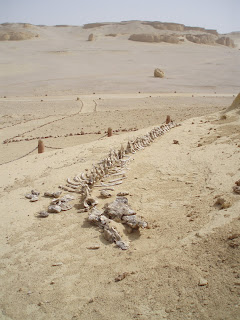
The path to the whales was clearly marked out by rows of red rocks.  I followed them to the first exhibit which displayed the fossilised lower jaw bone, ribs and vertebrae of an ancient whale known as Basilosaurus Isis, a type of whale that still had functional hind limbs from an earlier phase as a land-based mammal.  It was marked by a circle of small red stones, followed by an inner circle of rope held by stumpy posts.  The fossils lay on the surface; while being impressive due to their antiquity, they were at the same time unimposing, as if they had been sitting there sunbathing within their little circle and I’d disturbed them.  Further remains followed: another type of whale called a Dorudon atrox, a short-toothed sawfish, the curious fossilised ‘burrows of wood digesting Teredo’, a marine turtle, and the fossilised mangrove roots that once formed a shallow coastline, and in which the various carcases of these animals had once become entangled.  Between the fossil displays were small domed huts containing information panels describing every aspect of the area’s history, and giving particular details about life here in ancient times.  All around, as I walked from exhibit to exhibit, unusual rock formations dotted the landscape; pillars of stone standing in the desert.  Over millions of years the weaker stone had been eaten away by the wind, leaving the harder stone standing.  The life history of each column was strikingly visible in the stratigraphy, worn by the rock like a striped jersey. 

My mental picture of an isolated area, deep in the desert, where the intrepid adventurer could find whale bones tantalisingly emerging from the sand had been composed both from fact and fiction, as most preconceived ideas tend to be.  The firm reality was, nevertheless, just as exciting. There is a strong sense of isolation and peace at the site, even with a visitor’s centre nearby.  At Wadi El Hitan it is possible to stand atop a rocky hill, listening to nothing but the wind whipping past your ears as you stare off at distant dunes and wind-formed shapes.  A moment later, in a domed mud-hut, you can learn about the history of the valley, without ever feeling that the modern information boards and constructions are intrusive.  The Nineteenth Century traveller within sat back in his chair and happily smoked on his pipe; apparently not all adventures can be tamed by a visitor’s centre and picnic zone, some adventures can be enhanced by them.