Monday, 31 December 2012

Wepet Renpet Nefert (or to non-ancient Egyptians, Happy New Year!)


The Egyptians would probably have been rather bemused by all the recent fuss about the 2012 apocalypse, because to them, every year was potentially their last.
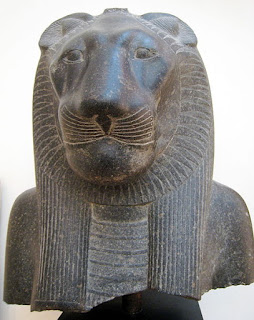
The Goddess Sekhmet,
National Museum, Copenhagen
The Egyptian civil calendar consisted of 360 days, with five 'days upon the year' added to the end. These five extra days were regarded as a dangerous, transitional time, when the goddess Sekhmet controlled  12 demonic murderers. These demons travelled the earth shooting arrows from their mouths, and caused plague wherever they wandered. To protect themselves, the Egyptians performed rituals and wore charms around their necks; this was thought to pacify Sekhmet, ensuring her protection instead of her wrath.
Remember this when moaning about your taxi being late this New Year's Eve night - it could be worse, you could be worried about phlegm-coated arrows being fired your way, or think that every odd cough is the onset of plague. It makes the norovirus look tame by comparison. 
New Year's Day itself - called wepet renpet 'the Opener of the Year' - was regarded as the birthday of the god Re-Horakhety. Although the Egyptians believed that the sun was reborn and grew old over the course of each day, they also saw the same process over the course of the year, with the sun born on New Year's Day and growing increasingly frail over the year's final few months. This is another reason why the end of the year was so dangerous: the sun god was weak and vulnerable to attack from his enemies, if he were to be defeated, the new year might never arrive.
Naturally, when the sun rose on New Year's Day, it was a time of great relief; the end of the world had been averted (again). People made offerings to Re-Horakhety at sunrise, and then poured black ink into the Nile for the goddess Nut and the god Nun. They also cleansed themselves by bathing in the Nile (perhaps getting covered in black ink in the process...). Afterwards, they applied their best green eye makeup and went off to get trashed at riotous banquets, proving once again that nothing ever changes.
A New Year's Flask in the Walters Art Museum, Baltimore
To celebrate the new year, courtiers gave gifts to the pharaoh, some with the words wepet renpet nefert inscribed upon them; this basically translates as 'Happy New Year.' Ordinary Egyptians also exchanged gifts, and took time off from work; the Deir el-Medina workmen - those who cut and decorated the royal tombs in the Valley of the Kings - took nine days off in total: the last day of the year, the five 'days upon the year', and the first three days of the new year. Not bad really.


So, this new year celebration, try to approach the occasion like an ancient Egyptian: keep safe from evil plague-infested demonic murderers this New Year's Eve, and (if awake and functioning) celebrate the rising sun on New Year's Day, safe in the knowledge that the sun god has defeated his enemies and has been reborn anew!

Wednesday, 19 December 2012

A Royal Mummy Murder Mystery: Was Pharaoh Ramesses III Assassinated?


It's a question that has bothered Egyptologists for over one hundred years: was Ramesses III murdered?

The Mummy of Ramesses III
Certain papyri record the trials of men and women involved in a plot to assassinate the pharaoh, but from these alone, it is difficult to tell whether the king survived the attempt on his life. One thing is sure, however, this was a large scale harem conspiracy, centred on a lesser royal wife called Tiye, who hoped to place her son, Prince Pentaweret on the throne; she was aided, not by a few scheming nobles, lurking in the shadows of the palace, but by a host of high ranking members of the administration, recruited by the chamberlain to the plot. Members of the treasury and army were also involved, as well as palace serving staff and scribes. Not content to rely solely on physical strength to overcome the king, the conspirators stole books of magic from the royal library, and used the instructions within to form wax figurines, designed to harm the royal bodyguard, and wax gods to hurt the king.

Whatever happened to Ramesses III, the plot was ultimately unsuccessful, and Ramesses IV, the intended heir to the throne succeeded him. The conspirators were sentenced to death, forced to commit suicide, or mutilated. Punishments were extended to family members too.

Now, when trying to determine whether Ramesses III survived the plot or not, you'd think that having his body would be a definite advantage, but no, all examinations proved inconclusive. When Gaston Maspero partially unwrapped the body in 1886, he found its bandages had hardened due to a thick resin coating; much to his disappointment I'm sure, the linen couldn't be removed without damaging the mummy. He did find 'mysterious figures drawn onto the bandages, however, and an image of the god Amun as a winged ram. These were unusual additions to the usual 'mummy package' and again raised the question, what had happened to the king?

This question couldn't be answered. Until now. 

Published in BMJ (Dec 2012, http://www.bmj.com/content/345/bmj.e8268), a recent study of Ramesses III's mummy, using CT-scanning and forensic analyses, has shown the unfortunate king to have a deep wound at his throat, perhaps caused by a knife. The attacker, it seems, sliced into the pharaoh's neck, cutting through his trachea, oesophagus, and large blood vessels, undoubtedly killing the king immediately. The royal embalmers, unwilling to commit their king to eternity with a gaping wound, placed a wedjet-eye (The Eye of Horus) into the cut to magically re-seal it (the Eye represents a return to completeness), and wrapped multiple layers of linen around his neck. Today, adorned with his linen scarf, Ramesses looks chic enough for a causal stroll down the banks of the Seine;  he only lacks his beret and cigarette. No wonder no one believed he'd been murdered, he seems far too serene.

But murdered he was, if the report is to be believed, and not only him - the research team also think they've found the body of Prince Pentaweret, previously known only as Unknown Man E. His DNA showed him to be related to Ramesses III, and there is a good chance that he died by strangulation (though the trial papyri state that Pentaweret killed himself, making strangulation a rather unlikely cause of death). His body was then mummified. Badly. As if the embalmers, were instructed to "get it done, but don't waste too much time on it." His internal organs and brain, typically removed during mummification, were left within, and his body was then covered with a 'ritually impure' goatskin.  In this condition, he was found in 1886, stored in the royal mummy cache at Deir el-Bahri (DB 320) alongside his father.

So now the arguments can begin afresh. Will the academic community challenge the results of the study? What further interpretations can be read into the evidence at hand?

Have we heard the final word on the demise of Ramesses III?

Friday, 7 December 2012

Another Extremely Positive Review!

An extremely positive review of The Pharaoh has appeared in Open Letters Monthly: An Arts and Literary Review, find it at: http://www.openlettersmonthly.com/book-review-the-pharaoh/